The Season of Light
From Joseph: The Hidden King & Yahshua by Dr. Kananalli
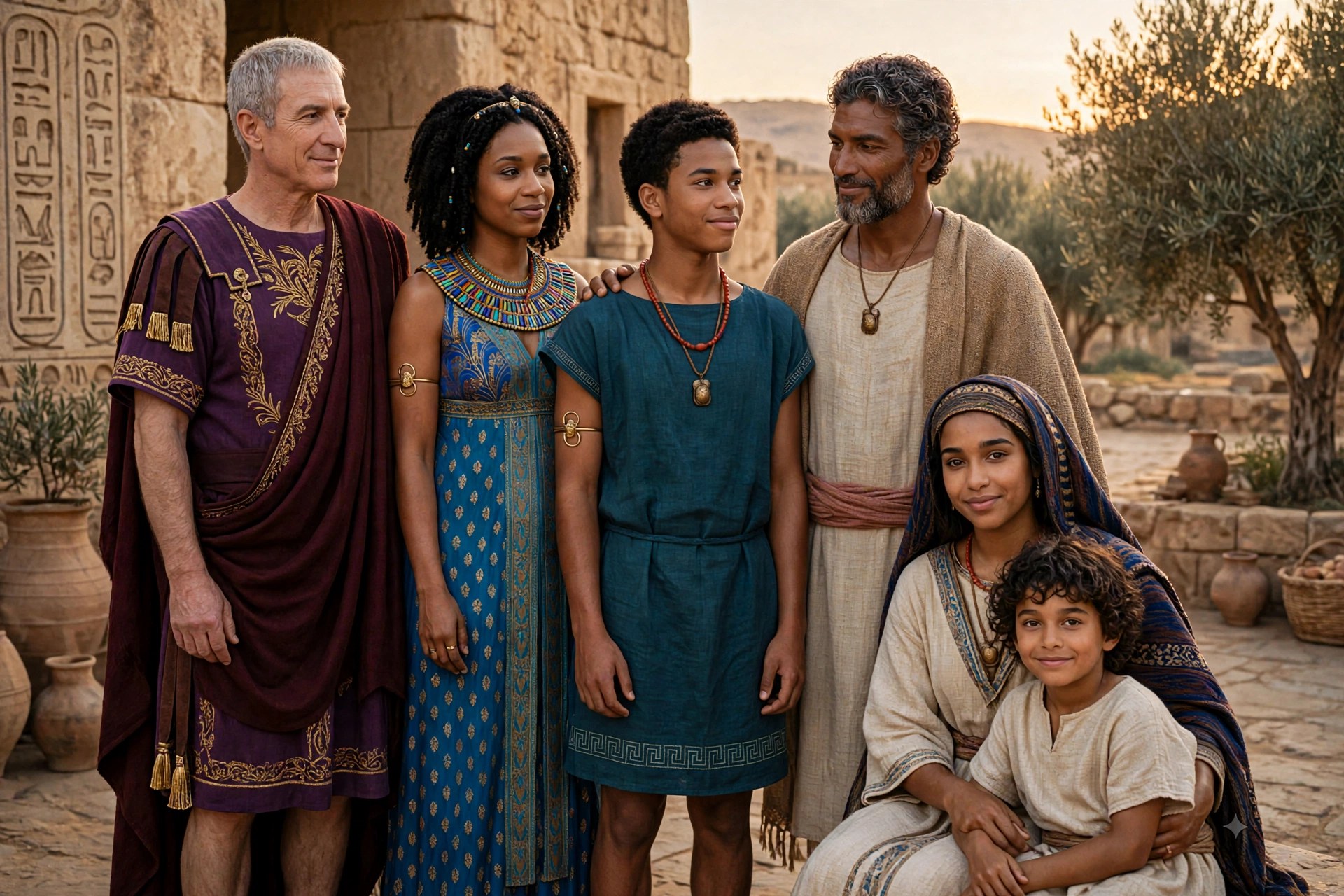
I was born Caesarion, son of Julius Caesar and Cleopatra, and I was seventeen years old when Alexandria fell and my name became a death sentence. I crossed the Sinai wrapped in the rough linen of a grain merchant’s apprentice, buried my crown in the desert sand, and took a new name in a new land: Joseph. I became a builder in the hills of Judea, a worker in wood and stone, and I have lived hidden ever since — a prince in exile who keeps his head down and his hands busy.
So when I speak of the festivals of this season, know who is speaking. Not a patriarch out of an old scroll. A man who knows palaces and hiding places, empires and small rooms. A man who learned that the light worth keeping is the light ordinary hands refuse to let go out. In the ages after mine, in lands I never walked, people keep their lamps through the darkest part of the year. Let me tell you what every one of them is truly keeping.
No code? Purchase the audiobook in the Shop
Christmas
The Love That Stands Guard
Christmas is mine. I do not tell it as a story I heard — I was there, and the child laid in the manger was my son. My own blood. The line of Caesar and Cleopatra, bound up with the house of David, carried in one small body that the empires of the world would have called a threat. Rome had already erased my life for being born to that blood. I knew what it hunted, because it had hunted me.
So understand what that night in Bethlehem truly was. A crowded town, and no door that opened. A young woman giving birth among the animals, and a child laid in a feeding trough because there was nowhere else clean to lay him. And me, awake, listening at the door with my staff in reach. In time, men came from the east — astronomers, readers of the sky, who had crossed deserts because they believed a child had been born who mattered. They were not kings to me. They were witnesses. And when the danger closed in, as I knew it would, I did what fathers do. I rose in the dark, gathered my son and his mother, and walked out into the night — back toward Egypt, the land I had fled, now the only road that could keep him alive.
That is the love Christmas carries: the love that stands guard. And look at whose hands did the keeping. Not heaven’s. A mother’s courage. A father’s watch. Strangers crossing a desert with gifts. The first guard around that child was human beings, standing between a baby and the dark. Remember that, and you hold the whole season in your hand.
Hanukkah
The Love That Will Not Go Out
Hanukkah belongs to the people who took me in. I came to Judea a fugitive with a price on my head, and these people — who owed me nothing and did not know my name — fed me, housed me, and in time let me become one of their own. Long before I was born, an empire held Jerusalem and defiled their Temple, the way empires always believe they can own what is holy. A small band of their own people — farmers and priests, not an army — fought their way back and cleansed it. When they came to relight the great lamp, they found consecrated oil enough for a single day. They lit it anyway. It burned for eight.
Empires, I understand. I was born to the two greatest names of the age, and an empire still erased my life in a single season. So hear me when I tell you what keeps that flame: not wonder. Hands. Somebody carried that one cruse of oil. Somebody trimmed the wick and struck the flame knowing it should not last. A people’s love is not soft — it endures, and it is practiced: lamps set in the window where the street can see, one more each night, so that no one in the dark walks past a house that has given up. They keep the light for each other. That is why it has never gone out.
Kwanzaa
The Love That Builds the Village
In an age far after mine, across a great ocean, a people carried out of Africa in chains built a festival out of what no chain could take from them. They call it Kwanzaa. For seven nights — from the day after Christmas to the first day of the new year — they light seven candles, black and red and green, and they call the village back to itself. I know what it is to be renamed by survival. Caesarion died in that desert so Joseph could live. So when I hear their seven charges, I hear my own life spoken back to me: be one people, not scattered strangers. Name yourselves, and answer to no name an empire gave you. Lift one another’s burdens as shared work. Build with your own hands, and keep your own tables. Live on purpose. Make new things. Believe.
And look at how they practice it — not in temples, but at tables. The harvest shared. The elders honored. Every child fed, and told whose they are. That is compassion with its sleeves rolled up: a people feeding, sheltering, and rebuilding one another, year after year, until the village stands again. No village stands on one man’s strength. I learned that in exile. They learned it in chains. The lesson is the same, and so is the love: the love that builds the village.
Diwali
The Love That Lights the Road Home
Far east of my country, in the same dark season, they keep Diwali — rows upon rows of small clay lamps along the roads, the windowsills, the banks of rivers. Their story tells of a prince who came home after a long exile, and of a whole city that lit lamps so he could find his way back through the dark. I listen to that story the way a man listens at a door he will never walk through. Alexandria was my home. I never saw it again. No lamps were lit for my return; my return would have meant my death.
So I do not begrudge that prince his lamps. I honor the hands that lit them. Because look whose work it is in that story — not the prince’s. The city’s. Thousands of ordinary people pouring oil, trimming wicks, setting small flames along a road for somebody else’s homecoming. That is compassion, plain as bread: a lamp lit for a traveler you may never meet, on a road you will not walk, in a night that is not yours. They do not wait for the beloved to arrive and then celebrate. They go out into the dark first, and make the road findable. Most days, love looks exactly like that.
Ramadan & the Eids
The Love That Widens the Table
In the years of my exile I crossed lands where the people marked their holiest month by the moon. Ramadan, they call it — a whole month where, from the first light of dawn to the setting of the sun, they take no food and no water, not as punishment, but as remembrance: to feel in their own bodies what the hungry feel every day, and to let that feeling turn their hands toward giving.
I have sat at their tables when the fast broke at sundown. Dates and water first, then bread passed hand to hand, doors open to neighbors and strangers alike — because a fast that does not end in feeding someone else has missed its own meaning. And when the month closes, Eid al-Fitr arrives like a door thrown open: new clothes, full tables, gifts for the children, and charity given before the feast, so that no house celebrates alone.
Later in their year comes Eid al-Adha, the festival of the sacrifice, remembering Ibrahim, who was ready to give up what he loved most. And in house after house the meat of the feast is divided three ways — for the family, for friends, and for the poor, whose portion is not the scraps but a full share.
Their season does not fall in this dark month — it travels with the moon through every part of the year. But its light is the same light: a table made wide enough for everyone, and no one eating alone.
One Spirit
Different Lands, Different Lamps, One Spirit
Four festivals. Four peoples who never sat at one another’s tables. A star over a stable. Lamps in a Temple window. Candles over a harvest table. Clay lights along a road home. Different lands, different tongues, different names — and one spirit moving through all of them. I will tell you what that spirit is, because I watched it grow up under my own roof.
My son Yahshua did not spend his life dazzling the world with wonders lowered from the sky. His miracles were miracles of compassion: bread broken for the hungry by human hands, the sick touched instead of shunned, the stranger and the outcast pulled in close to the fire. Again and again, the same holy act — one person refusing to let another face the dark alone. That is the whole of his teaching, and it is the whole of this season.
Christmas: a father standing guard over his son. Hanukkah: a people keeping the flame for each other. Kwanzaa: a village feeding and rebuilding its own. Diwali: a city lighting the road for the one still traveling. Not divinity descending. Human beings, keeping light alive for each other in the darkest part of the year. I buried a crown in the sand and took up a builder’s tools, and this is the deepest thing I ever learned: kingdoms fall, empires erase names, and the only light that has ever lasted is the kind ordinary hands keep for one another. Whatever lamp your house holds this season, hold it up for somebody else. Somebody is finding their way home by it.
A Message from Joseph
I was born Caesarion, son of Caesar and Cleopatra, and I lost a throne before I ever sat on one. Rome erased my name. I crossed the desert with nothing and took a new one — Joseph. I tell you that so you know: I know what it is to be shut out, to be told there is no place for you.
Everything the world calls holy in my house began at a table. My son Yahshua taught me that a miracle is not thunder from the sky. It is bread broken and passed hand to hand. It is a door opened to the one still standing outside it. Compassion is the strongest power on this earth, because it is the only one that grows when you give it away.
That is why this season matters. In the darkest part of the year, every people lights something — a candle, a lamp, a fire in the center of the room — and gathers around it, and in that gathering no one is cold alone.
I have watched what happens in this place, where artists who were told there was no room for them are given a room, and a microphone, and people who listen. One voice alone can be turned away. A hundred voices raised together cannot be ignored. So come together. Feed each other. Make room at the table. And keep your light lit — not for yourself, but so somebody lost can find their way home by it.
Hear Joseph’s Full Story
Joseph: The Hidden King & Yahshua — the complete trilogy, told in full, in the same voice you just heard.
LISTEN ON THE JOSEPH PLAYER